Hosting Cost per kWh: The Number That Decides Everything
Mining is a spread trade between two numbers: what a kilowatt-hour earns you, and what it costs you. At current difficulty a 10 PH/s fleet of 20 J/TH machines produces about $379.93 of gross income a day while consuming 4,800 kWh — roughly $0.079 per kWh earned — so a hosting price at $0.045/kWh leaves about $148.73 a day after the listed pool fee, while $0.075/kWh leaves about $4.73. Same hardware, same pool, one number different.

Key takeaways
- Revenue per kWh is the ceiling. At 20 J/TH and 10 PH/s it is about $0.079/kWh gross, or roughly $0.076/kWh after the listed 4% fee on the PPS-settled block reward — any hosting price above that is a losing spread.[1]
- Efficiency is part of the spread, not a separate project: the same 10 PH/s at 30 J/TH consumes 7,200 kWh a day, which costs $432 at $0.06/kWh against roughly $364.73 of fee-adjusted income.
- Cooling is a hidden multiplier. A 1.15 power-usage-effectiveness figure turns 4,800 kWh into 5,520 kWh, adding about $43 a day at $0.06/kWh.
- Fixed power costs meet variable mining income, so the payout mode matters: PPS+ settles hourly against current difficulty, while PPLNS distributes after six confirmations over the last five difficulty rounds.[2]
The core idea
Renewable developers talk about levelised cost; miners should talk about levelised revenue per kilowatt-hour. It is a single division: daily gross mining income divided by daily consumption. Everything else — hardware generation, pool choice, firmware, overclocking — either changes the numerator, changes the denominator, or does nothing at all.
The denominator is fixed by physics. A machine's efficiency figure, in joules per terahash, multiplied by its hashrate, gives watts; watts multiplied by 24 gives the daily consumption you will be invoiced for. A 1 PH/s slice at 20 J/TH draws 20 kW, or 480 kWh a day. At 30 J/TH the same hashrate draws 720 kWh. The numerator moves with difficulty and price, both of which are outside your control, which is exactly why the denominator deserves attention.
The comparison to make, therefore, is never "is this a cheap hosting rate". It is "is this rate below my revenue per kilowatt-hour, and by how much of a margin". The answer changes every difficulty adjustment.
How it plays out at scale
Scale magnifies the spread rather than changing its shape. A 10 PH/s fleet at 20 J/TH draws about 200 kW, or 4,800 kWh a day, and produces roughly $379.93 of gross income at a $84,692 BTC price. Applying the listed 4% fee to the block-reward component leaves about $364.73, and the difference between that and the electricity invoice is the number the operator lives on.
| Line, per day | $0.045/kWh | $0.06/kWh | $0.075/kWh |
|---|---|---|---|
| Consumption | 4,800 kWh | 4,800 kWh | 4,800 kWh |
| Gross mining income | $379.93 | $379.93 | $379.93 |
| After listed 4% fee on the block reward | $364.73 | $364.73 | $364.73 |
| Electricity invoice | $216.00 | $288.00 | $360.00 |
| Residual per day | $148.73 | $76.73 | $4.73 |
| Residual per machine per day (100 machines) | $1.49 | $0.77 | $0.05 |
Three cents per kilowatt-hour separate a healthy operation from one that is one difficulty adjustment away from switching off. That is the whole argument for treating the power price as the primary term of the deal and the hardware as the thing that has to fit underneath it.
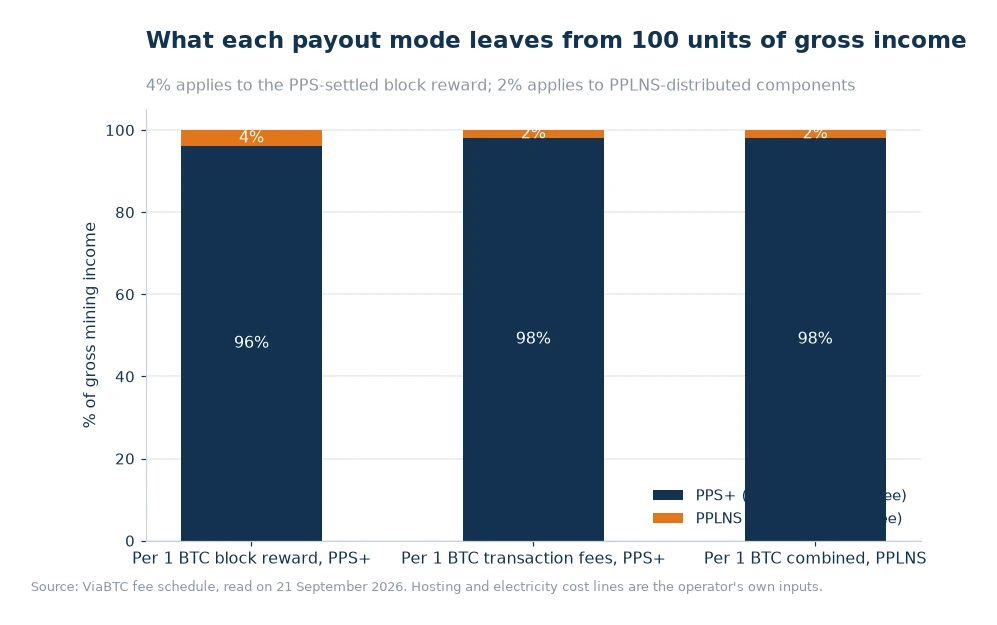
Two details in that chart repay attention. The fee applies to income, not to your spread: a fleet with a 25% margin pays the listed fee on the whole income figure, so the fee's effect on the residual is several times larger than the headline percentage suggests. And the fee is charged per component, not as one blended number — 4% on the block-reward part of a PPS+ payout against 2% on the PPLNS-distributed part, which is a different calculation from a flat 6% on everything.
Two scenarios compared
Scenario one is the fleet above at $0.045/kWh, on a contract that includes cooling. The residual is about $148.73 a day, or $4,462 in a thirty-day month, and the spread can absorb a difficulty increase of roughly 40% before it disappears. That is a durable arrangement.
Scenario two is the same 10 PH/s at $0.075/kWh with unmetered cooling priced separately. The residual is about $4.73 a day, or $142 a month, and cooling that adds even a 10% overhead pushes the arrangement into a loss. The hardware has not changed, the pool has not changed, and the operator's outcome has gone from comfortable to unsustainable.
Now change the hardware instead. The same 10 PH/s built from older 30 J/TH machines consumes 300 kW, or 7,200 kWh a day. At $0.06/kWh that is $432 against $364.73 of fee-adjusted income — a loss of about $67 a day, before any cooling overhead. This is the second reading of the same lesson: efficiency and power price are one variable seen from two sides, and the arithmetic only has to be done in one direction to make the decision obvious.
Common failure modes
- Quoting the wrong kilowatt-hour. A rate that excludes cooling, transformation losses or facility overhead is not the rate you pay. Ask for all-in consumption at the meter.
- Assuming difficulty is static. The adjustment after these figures were read was estimated at about -2.12%, which is a reminder that the numerator is not fixed either. Re-run the spread monthly.
- Ignoring the fee line. A blended fee assumption hides the split between the 4% block-reward component and the 2% component distributed under PPLNS logic, and over a year that misreading is material.
- Matching PPLNS payouts to fixed invoices. Power is billed on a schedule; PPLNS distributions follow blocks. If your cash buffer cannot bridge a slow fortnight, hourly settlement is worth the higher listed fee on the block-reward component.
- Forgetting the revenue-side levers. Merged mining on multi-coin mining pools can add output on the same hardware, and a pool dashboard is how you confirm the extra hashrate is actually being credited.
- Buying hardware before securing the spread. Machines can be sourced in weeks; power contracts take longer. Model the deal with the power price you can actually sign, not the one advertised in a listing.
Where the two sides meet is the hosting arrangement itself, which is why some miners prefer to fold power, rack space and pool access into one relationship rather than negotiating three contracts: ViaBTC Mining Farms is the optional hosting entry point on the pool side, useful when the goal is a single invoice and a single dashboard for both the hashrate and the power behind it.
Frequently asked questions
Can I mine more than one coin at the same time?
Yes. Merged mining lets a machine secure a parent chain and an auxiliary chain together, and multi-coin pools support switching between chains without moving hardware.
Do mining pools cost anything to join?
Joining is free; the pool earns from its fee on settled payouts, which appears as a percentage of the block-reward and transaction-fee components.
What hosting price is too high?
Compare it with your revenue per kilowatt-hour: at 20 J/TH and current difficulty that is about $0.079/kWh gross, or roughly $0.076 after the listed 4% fee on the block reward. A price at or above that figure leaves nothing for cooling, maintenance or difficulty drift.
Do the division once a month
Divide daily income by daily consumption and write the number down. Then subtract your all-in hosting price and see what is left. Two cents per kilowatt-hour is worth more than most hardware upgrades, and the arithmetic takes about a minute. Do it monthly, alongside a check of your effective hashrate on the dashboard, and the decision about which machines to keep running makes itself.
Data and sources: ViaBTC pricing[1], the ViaBTC fee breakdown[2] and public chain difficulty data. Network difficulty (132.76 T), network hashrate (about 1,003 EH/s), the 3.125 BTC block subsidy, BTC at 84,692 and the estimated -2.12% difficulty change were read on 21 September 2026; everything above is calculated from those inputs plus the stated efficiency and electricity assumptions, and all of it moves when difficulty or price moves.